- Support Home
- Knowledge Base
- Tracking And Reporting
- Click Tracking
- Setting up tracking domains
Related articles
Need some help?
If you have questions or can't find what you're looking for, we're here to help.
Taguchi Support is available 24 hours a day, Monday to Friday.
Create New TicketTaguchi Certified Training
Join our free and live online training sessions. You'll benefit from a better understanding of the platform's features and functionality. Plus with Taguchi Certified Rewards, every session you attend, you're not just learning - you're earning your way to some fantastic rewards.
About Taguchi Certified RewardsAPI Version 5
Did you know Taguchi has an API that supports all of the functionality provided by the admin interface and more?
Explore API Documentation
Thanks for your feedback!
Setting up tracking domains
Tracking domains may be used for open and click tracking in emails, click tracking in SMS, website behaviour tracking and Taguchi web page hosting.
A custom tracking domain allows your organisation to use a domain you own for tracking links, cookies, web tracking, and related browser-based activities instead of using the default Taguchi domain.
Instead of recipients seeing a generic tracking link such as:
https://example.taguchimail.com/
They see a branded link like:
https://click.example.com/abc123
Why set up a tracking domain?
A custom tracking domain provides greater control over your tracking infrastructure, improves brand consistency, and supports more reliable tracking between email interactions and website activity.
Benefits of a custom tracking domain
Branded customer experience
Uses your organisation's domain in tracked links, creating a more recognisable and trusted experience for recipients.
Supports deliverability best practices
Helps maintain a consistent brand identity across emails and links. While it can support deliverability, it is only one factor alongside sender reputation, authentication, engagement, and list quality.
First-party cookie tracking
Allows tracking cookies to be associated with a customer-owned domain, supporting improved email-to-website attribution, visitor recognition, and customer journey tracking (subject to browser restrictions and consent requirements).
Improved tracking and attribution
Helps connect email interactions with website activity, making it easier to measure conversions, customer journeys, and campaign performance.
Supports embedded content and integrations
Provides a customer-owned domain for browser-based features such as:
- Embedded forms
- Preference centres
- Personalised content
- iframe-based experiences
- CORS-enabled integrations
This can improve compatibility and simplify security configuration.
Supports privacy and security requirements
Provides a first-party tracking approach that is better aligned with evolving browser privacy changes and enterprise security requirements.
Complements email authentication
Works alongside SPF, DKIM, and DMARC to support a consistent email identity. A custom tracking domain does not directly provide DMARC alignment.
What is a Click Tracking Domain?
When Taguchi tracks clicks, it rewrites every link in your email to pass through a redirect URL first — logging the click before sending the subscriber to the final destination. That redirect URL is what the tracking domain controls.
So instead of a link going straight to your website, it passes through your tracking domain first (e.g. clicks.yourbrand.com/...) before redirecting to the final URL. This allows Taguchi to record who clicked, when, and on which link.
Why a subdomain instead of your root domain?
Taguchi requires a subdomain (e.g. clicks.yourbrand.com) rather than your root domain (e.g. yourbrand.com). Here's why:
Technical conflicts with your website — Your root domain already points to your web hosting. A tracking domain also needs to point somewhere — you can't send the same domain to two places at once. A subdomain sidesteps this conflict entirely.
Protecting your root domain reputation — Spam filters and security tools (such as those built into Gmail, Outlook, and corporate firewalls) scan the domains inside email links. If your root domain appears in high-volume email redirects, it can get flagged or throttled — which could damage the domain you rely on for your website and SEO.
Isolating blacklist risk — Tracking domains can occasionally end up on URL blacklists. Isolating click tracking on a subdomain means a blacklisting event doesn't affect your main website's domain reputation.
Branding in link previews — When recipients hover over a link (or a security tool inspects it), they see the tracking domain URL. A branded subdomain like
clicks.yourbrand.comlooks intentional and trustworthy, rather than a generic third-party URL.Easy to replace if needed — If a tracking subdomain ever develops a poor reputation, you can set up a fresh one and update it in Taguchi — with no impact to your root domain, website, or other operations.
In short: the tracking domain is a dedicated "middleman" URL that handles all click redirects. Keeping it on a subdomain protects your main website's domain from any reputational or technical side effects of high-volume link tracking, while still keeping it visually on-brand.
Recommended setup
For most organisations, we recommend setting up a dedicated subdomain specifically for tracking (for example, click.example.com) rather than using your root domain. This keeps your tracking infrastructure separate from your main website while maintaining a branded customer experience.
How to set up a custom tracking domain
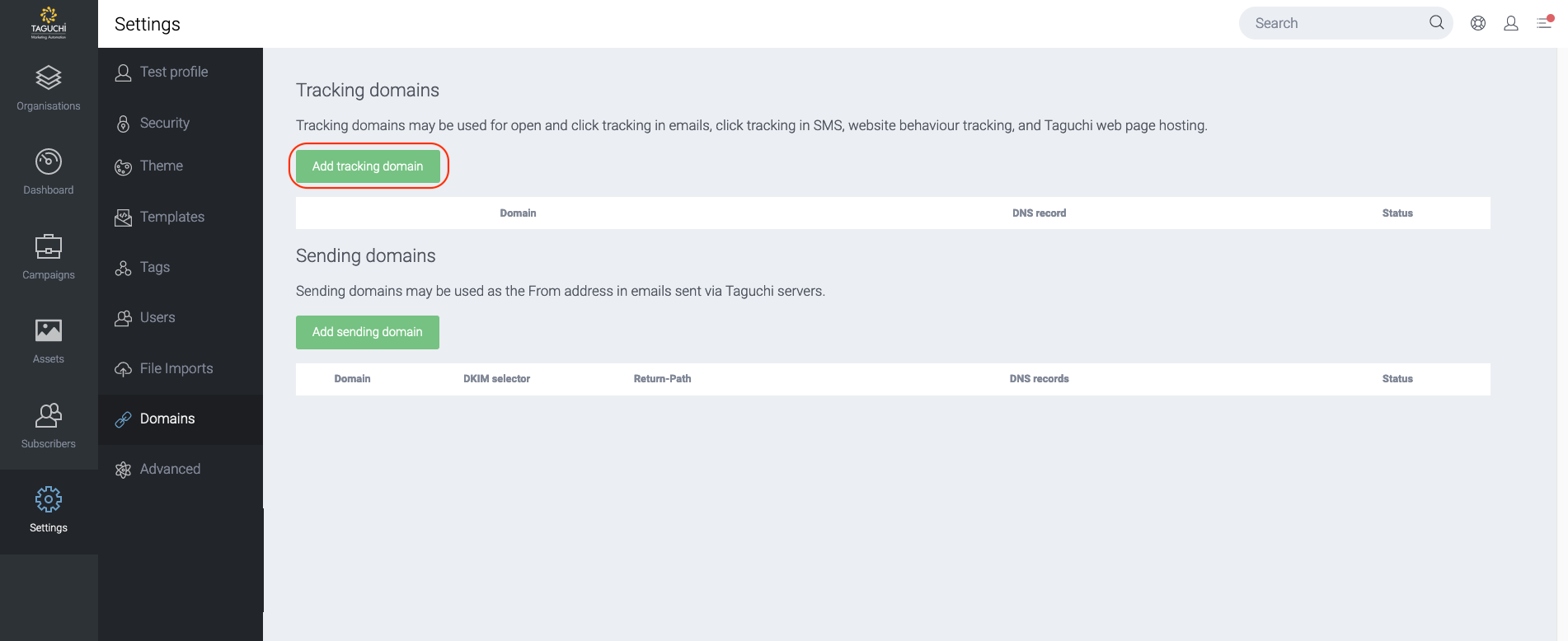
- An administrator of your organisation needs to configure the tracking domain in the Settings > Domains section of Taguchi.
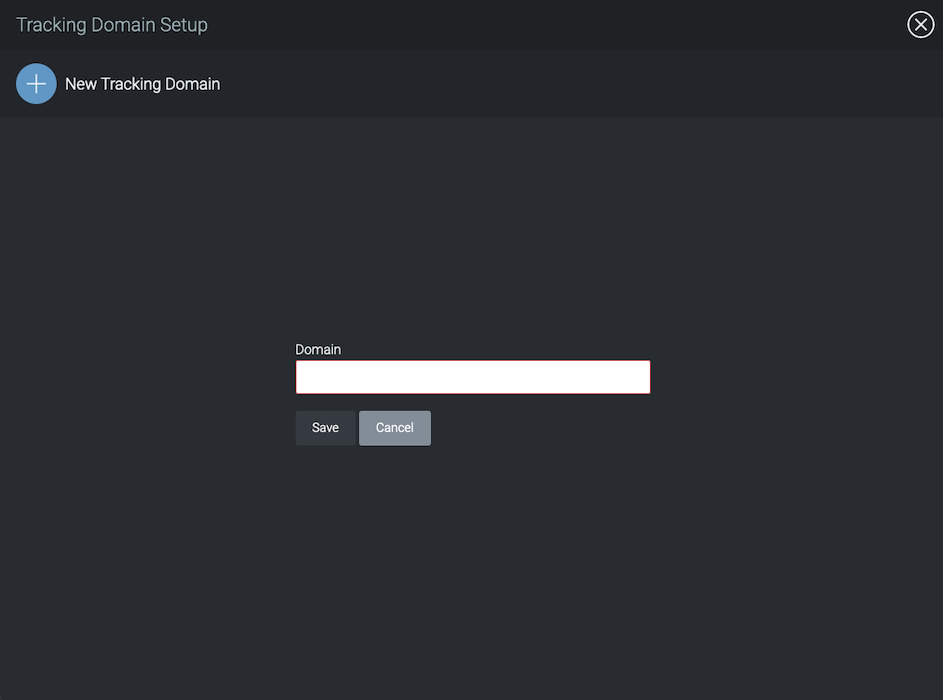
- Click 'Add tracking domain' and then input the click tracking domain and click 'Save'. If it doesn't appear to be added refresh page
- You will then need to set up a sub-domain on your existing domain and add the CNAME record, which can be found under the "Tracking domains" heading. If you need assistance with this please contact Taguchi Support.
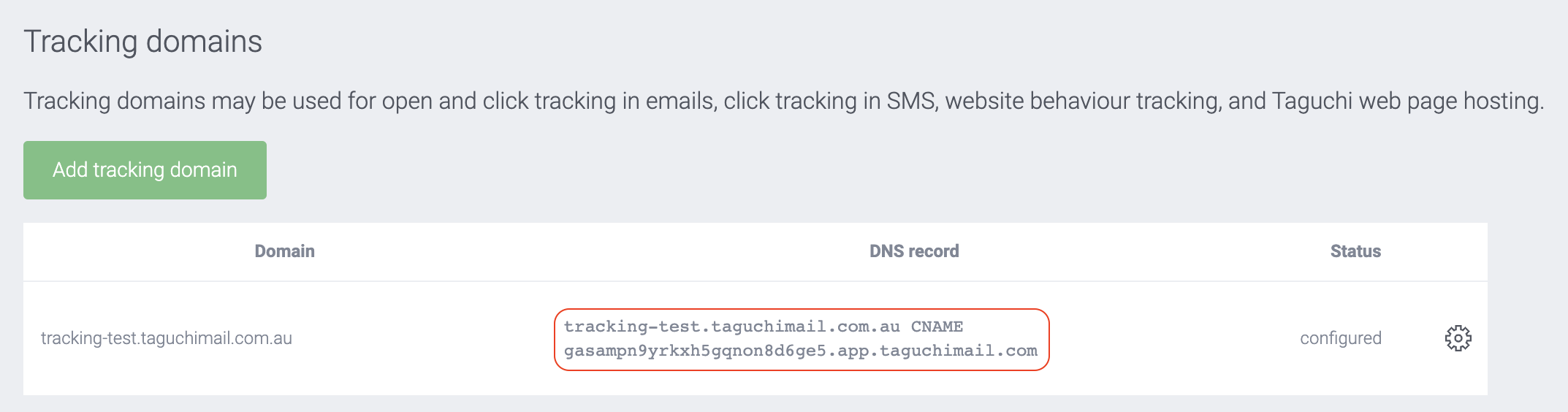
- Once you see the status go from 'Pending' to 'Authorized', this confirms we have detected a DNS record is pointing to us (this usually takes within an hour). The next morning the status will then change to 'Configured' once it has been provisioned on our servers. If the status displays 'pending' for longer than 24 hours please contact Taguchi Support for assistance.
- The changes will be applied automatically between 8–9am daily.
- Once the sub-domain has been configured for custom click tracking, your custom click tracking domain is ready to go.
If your click tracking domain set up in Taguchi is still on the 'Pending' status after 24 hours or more, this indicates that the DNS record has not been set up/is incorrectly set up. Please contact your domain manager to resolve.
During the custom tracking set up process, an SSL certificate will be automatically applied to the sub-domain. The Domain section is only available for users with administrator rights. Contact Taguchi Support if you see any issues with this configuration.
Ensuring your emails use your custom click tracking domain
Custom click tracking is configurable within template themes.
Simply navigate to 'Settings' > 'Themes' and select the appropriate theme. If you have not yet set up a theme, please refer to our documentation on creating themes. Documentation on this topic.
Once you have selected your theme, scroll down and open the 'Click-Tracking Domain' section. The first part allows you to set up the click tracking domain for that theme. In the dropdown 'Tracking Domain Name', select the click tracking domain you previously set up. Emails using that template theme will now use your custom click tracking domain.
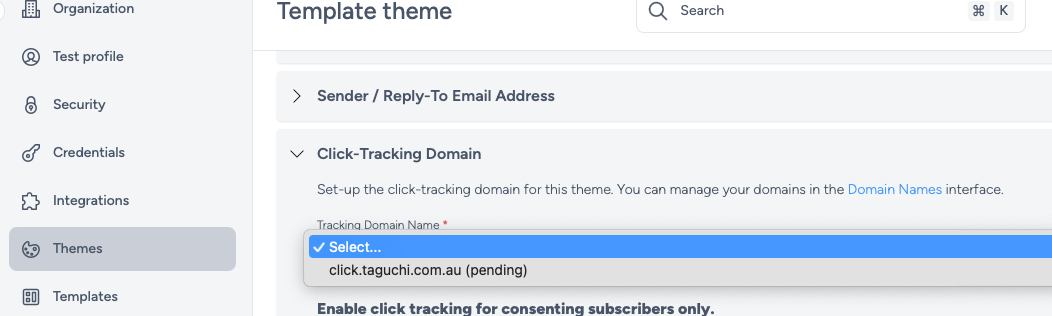
If the status of the click tracking domain is still 'Pending' and you select the domain for your theme, links in emails using that domain, will fail to load. Ensure status is 'Authorised'. Contact Taguchi Support if you see any issues with this configuration.
Ensuring your SMS uses your custom click tracking domain
Custom click tracking is configurable within our out-of-the-box messaging integrations.
As part of the integration setup, there's a section called 'Tracking Domain (Optional)' In this section, use the dropdown to select your custom click tracking domain.
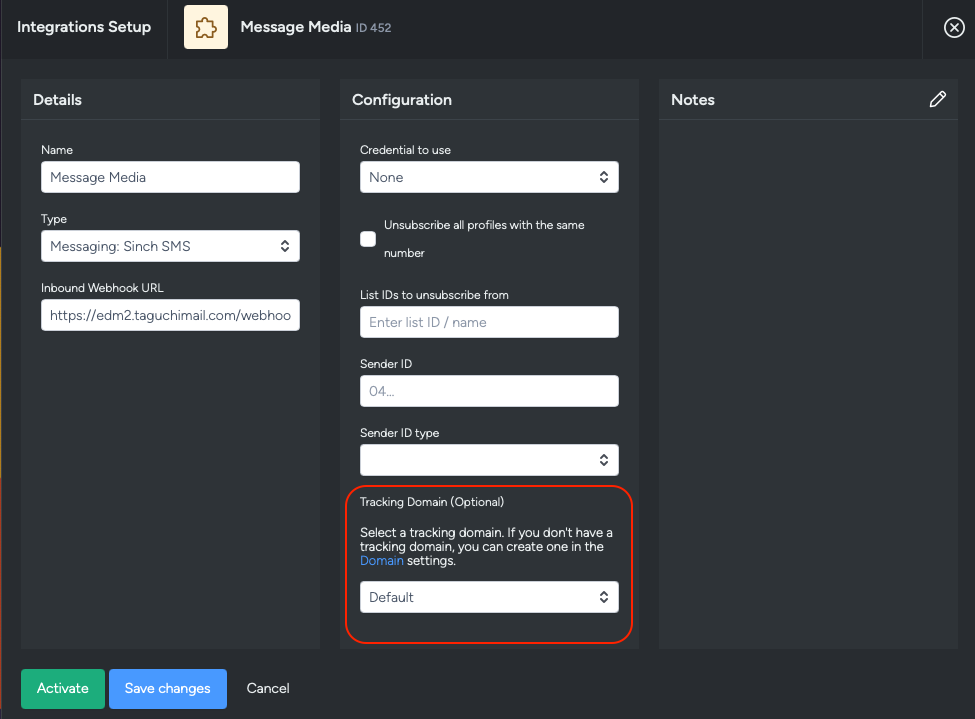
You can leave it as the default Taguchi click tracking domain. See our article on click tracking for more information on the structure of this click tracking.
URL Structure in SMS
Important: Ensure all URLs in your SMS content start with https://www./ (e.g., https://www.example.com)
This URL structure is essential for:
URL Shortening: URL shortening only works when URLs start with https://www./ - this helps keep your SMS within the 160 character limit, especially when using personalisation.
Click Tracking: Without the https://www./ prefix, click tracking will not work, preventing you from measuring campaign performance and setting up appropriate follow-ups.
Ensuring your web form or page uses your custom tracking domain
If you are using the same tracking domain as your click tracking, ensure you use a theme that defines that domain as the click tracking domain. See Ensuring your emails use your custom click tracking domain and creating themes.
If you are using a different domain, create a separate theme for web and select the different domain for that theme.
Defining your custom tracking domain for web tracking
When implementing Taguchi web tracking on your site, ensure the cookie loads over your custom tracking domain. See Page Tracking.
💬 For further assistance, contact Taguchi Support.