- Support Home
- Knowledge Base
- Campaigns And Activities
- Content
- Asset Library
Related articles
Need some help?
If you have questions or can't find what you're looking for, we're here to help.
Taguchi Support is available 24 hours a day, Monday to Friday.
Create New TicketTaguchi Certified Training
Join our free and live online training sessions. You'll benefit from a better understanding of the platform's features and functionality. Plus with Taguchi Certified Rewards, every session you attend, you're not just learning - you're earning your way to some fantastic rewards.
About Taguchi Certified RewardsAPI Version 5
Did you know Taguchi has an API that supports all of the functionality provided by the admin interface and more?
Explore API Documentation
Thanks for your feedback!
Asset Library
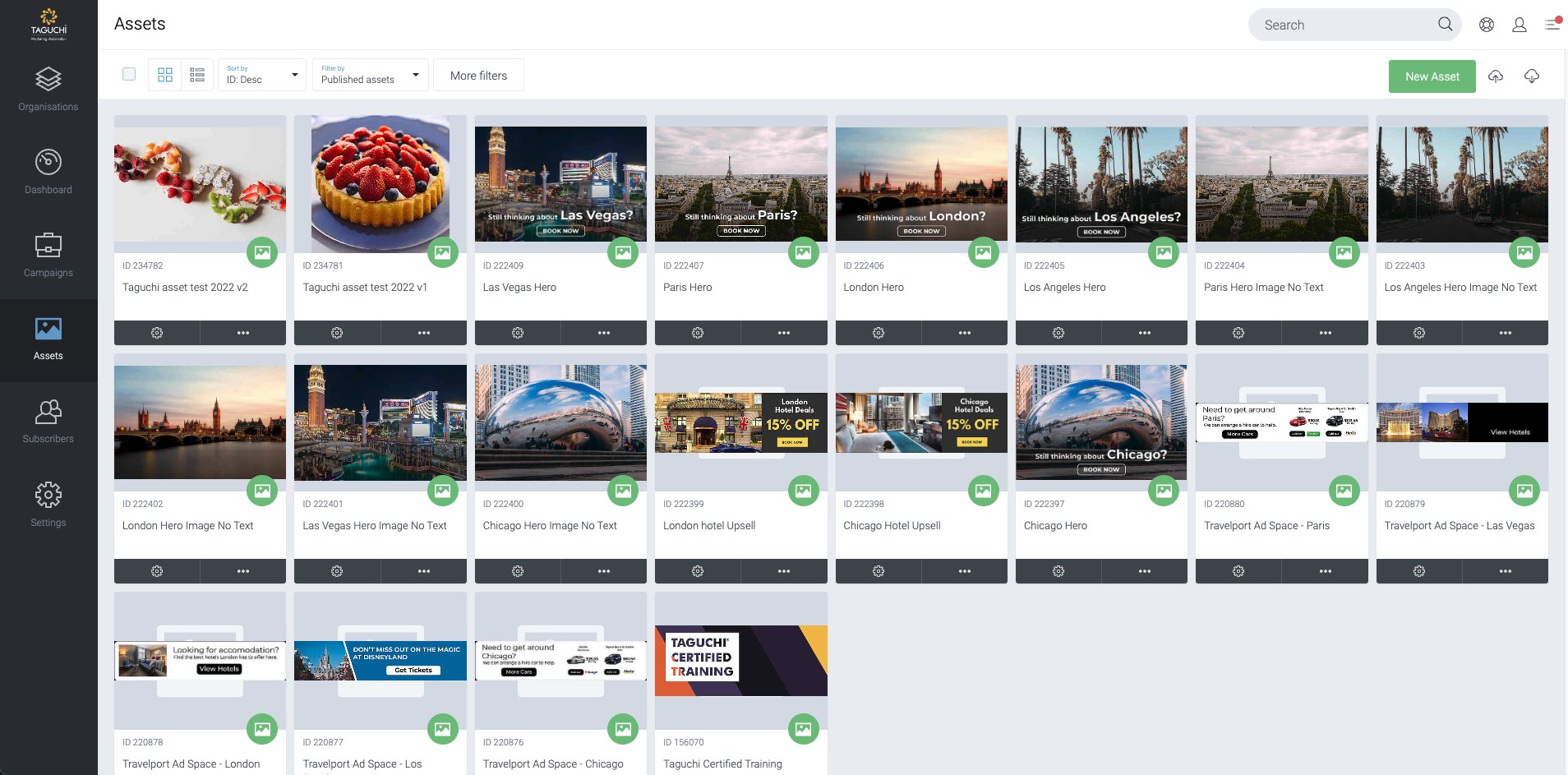
The Asset Library is a centralised location for creating, managing, and updating reusable content blocks. Dynamic assets can include image, article, image-caption, raw-text, form-control, grid and composite assets that can be customised and targeted to specific audiences. Customisation refers to modifying the values or properties within an asset (e.g., updating a title or changing a price). Targeting refers to determining who should see an asset—such as limiting visibility to subscribers in Victoria or New South Wales.
In supported activities, selecting an asset opens the asset editor. This supports grids, blocks and legacy assets across email, web and IAM assets, and compatibility icons indicate where each asset can render.
Using the Asset Library significantly streamlines your workflow. Instead of updating every instance of an asset manually, you can make changes once—directly in the library—and have those changes flow through to all associated email activities. This improves efficiency, personalisation, and the relevance of content delivered to recipients.
This is what the Asset Library looks like:
Setting Up the Asset Library
You can create an asset by selecting New Asset in the top-right corner of the screen.
The new asset will open in a pop up on the setup tab.
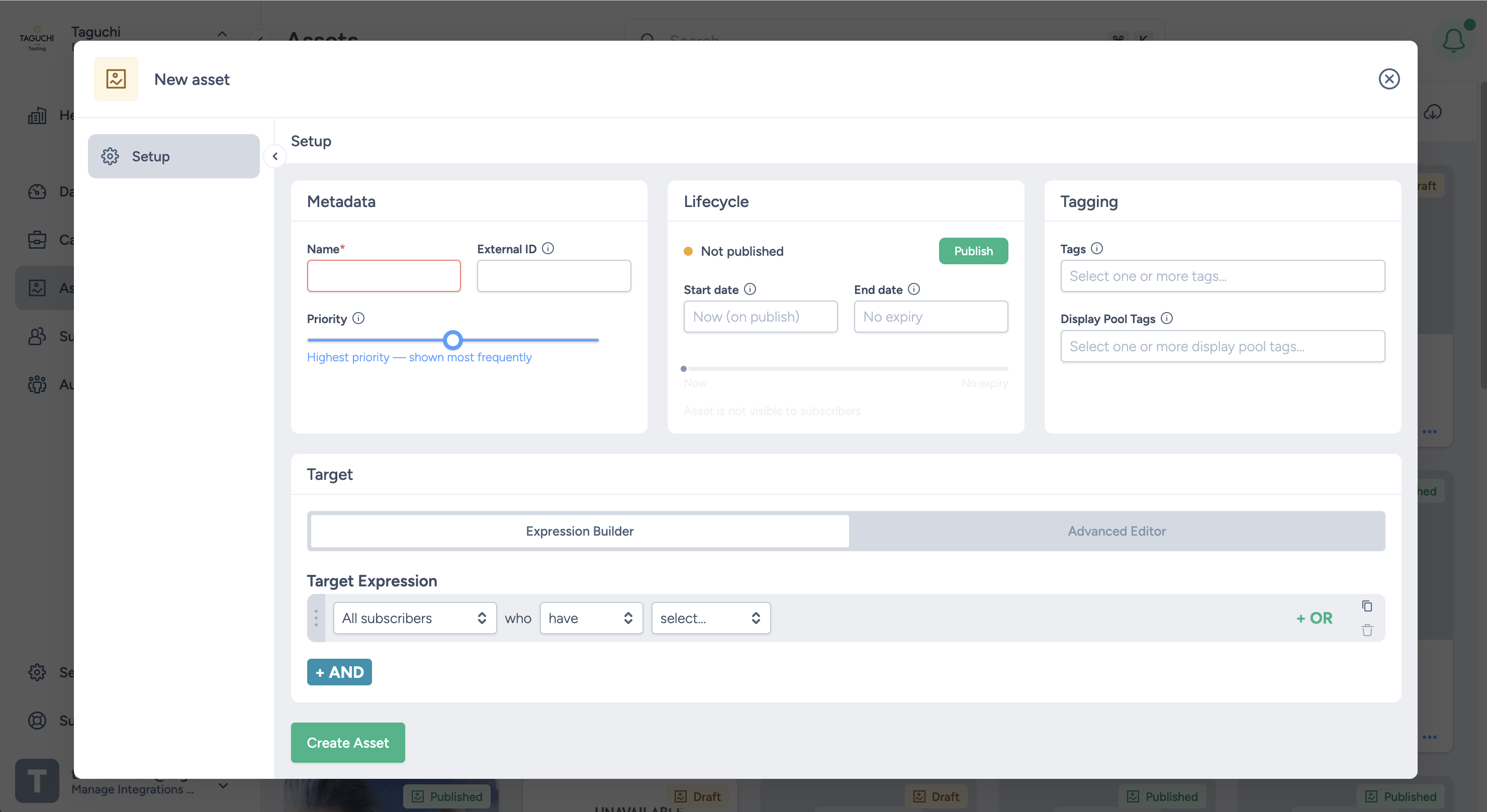
The setup tab allows you to configure the asset's metadata, lifecycle, tagging and target.
Once you've configured these elements, click on the 'create asset' button at the bottom left of the pop up.
Once you create your asset, other tabs will be available.
These tabs are:
- Edit - where you can select or change your asset type.
- Partitions - where you can allocate your asset to specific partitions. (How do I select partitions for an activity?)
- Coupon pairing - where you can pair the asset with your coupouns. (What are coupons and how can I use them?)
- Analytics - where you can see the number of recipients who could see the asset.
Asset types and supported channels
Asset templates and channel compatibility are organisation-specific.
- Templates may support email, web, IAM, or a combination of channels.
- Use the compatibility icon to confirm where an asset can render before using it in an activity.
- Grids/composite assets can be reused either as a dynamic reference or as a static copy.
Asset Setup
Select and edit asset type
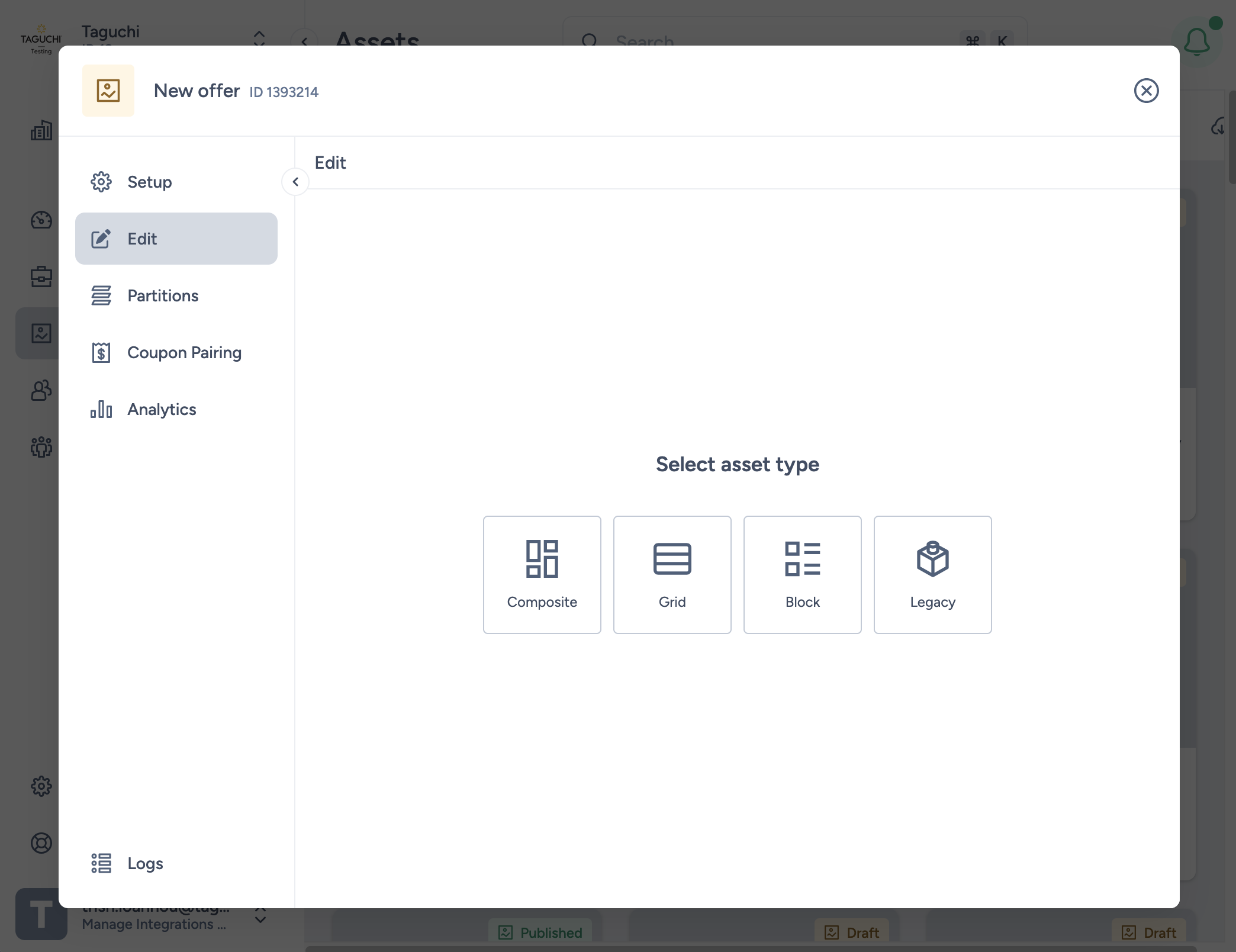
The Edit tab allows you to select the type for a newly created asset. For an existing asset, use the asset type selector to choose another available type.
The options are:
- Composite - multi-block asset or a saved content section
- Grid - a row of content
- Content Block - a single block of content
- Legacy - pre-defined asset templates available to specific organisations
Content Block, Grid and Composite assets can be switched between after creation. The types available in the selector depend on the asset being edited. Legacy assets do not support asset type switching and cannot be converted to another type.
To change an existing asset's type:
- Open the asset from the Asset Library.
- Select the Edit tab.
- Open the asset type selector and choose an available type.
- Review the compatibility warning before continuing.
Switching from a simpler asset type to a more complex type preserves the existing content. Switching from a more complex type to a simpler type may remove content that is not compatible with the selected type. Review the asset after switching to confirm that the expected content remains.
Important: Changing an asset type may result in content loss. Taguchi displays a warning before the change because not all existing content may be compatible with the selected type.
Once you've selected your asset type, you can drag and drop compatible blocks on the right-hand side preview area.
Setup
Metadata
- Name — Specifies the name of the asset
- External ID — Optional field for assigning a unique identifier
- Priority — Defines display priority as a slider
- 0 is the highest priority.
- Values increase in increments of 0.1, up to 10.
Lifecycle
- By default a new asset is not published
- Click the 'Publish' button to publish an asset
- Start Date — Defines when the asset becomes active
- End Date — Defines when the asset becomes inactive (not visible to subscribers)
- Select a start date in the future to schedule the asset
- If the start date is left blank, the system assigns the current date/time
- Once published the start and end date and time will be visible
- If end date is left blank, the asset will show indefinitely
Tagging
- Tags — Used for selecting which assets can display in an activity
- Display Pool Tags — Used to prevent multiple assets from the same pool appearing together
Target
This section lets you define which recipients should see the asset using a target expression.
If you want the asset to be shown to everyone, leave this section blank.
For more information on target expressions, see
'What are target expressions?'
Partitions
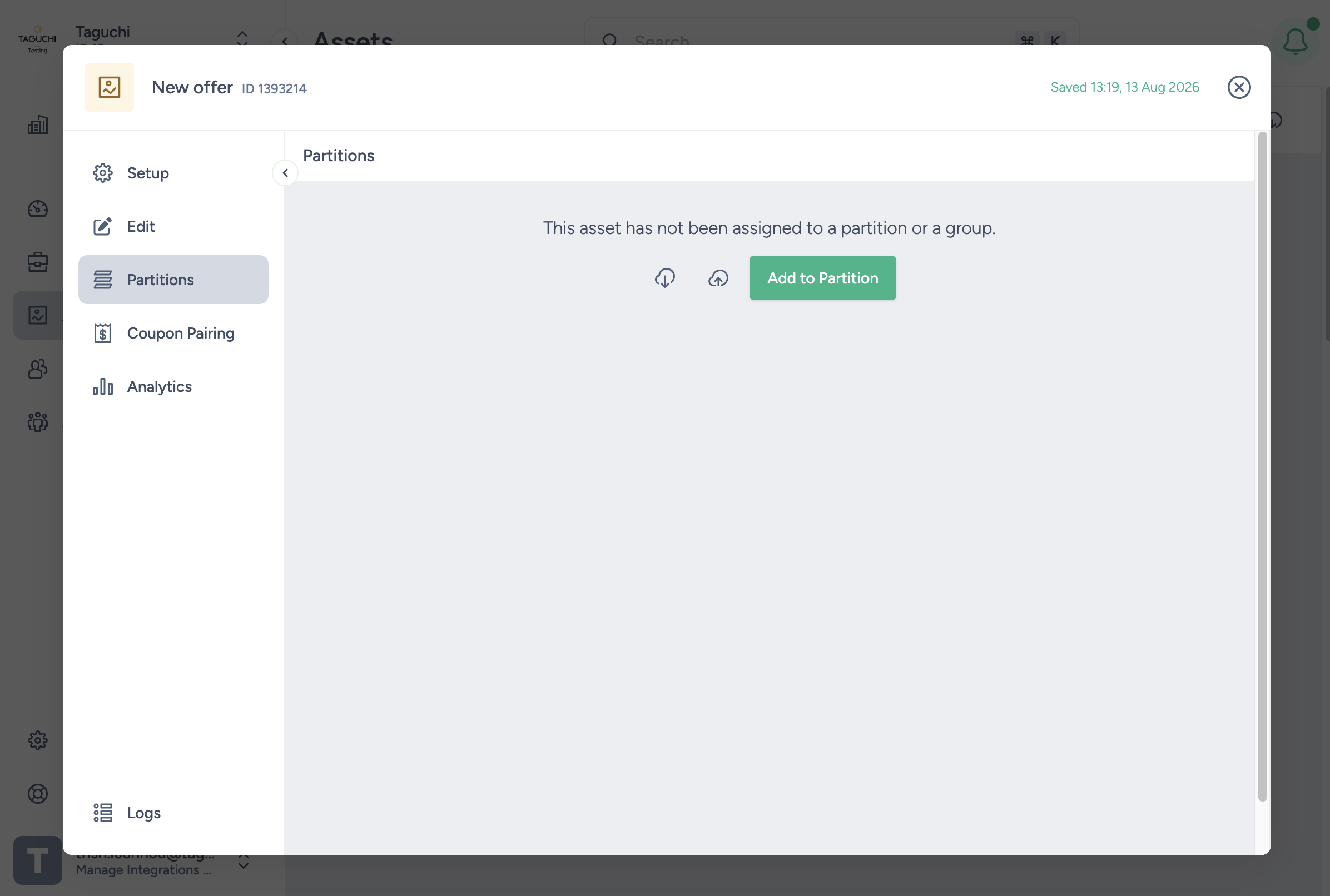
This secltion allows you to assign an asset to a partition.
Click 'Add to partition' to select which partitions you want to assign the asset to.
For more information on partitions, see How do I select partitions for an activity?
Coupon Pairing
This section links the asset to a coupon type.
When paired, coupon values can appear within the asset (e.g., captions or links).
Important: An asset must have a target expression in order to pair coupons. This ensures the system knows which targeted subscribers should receive which coupon codes.
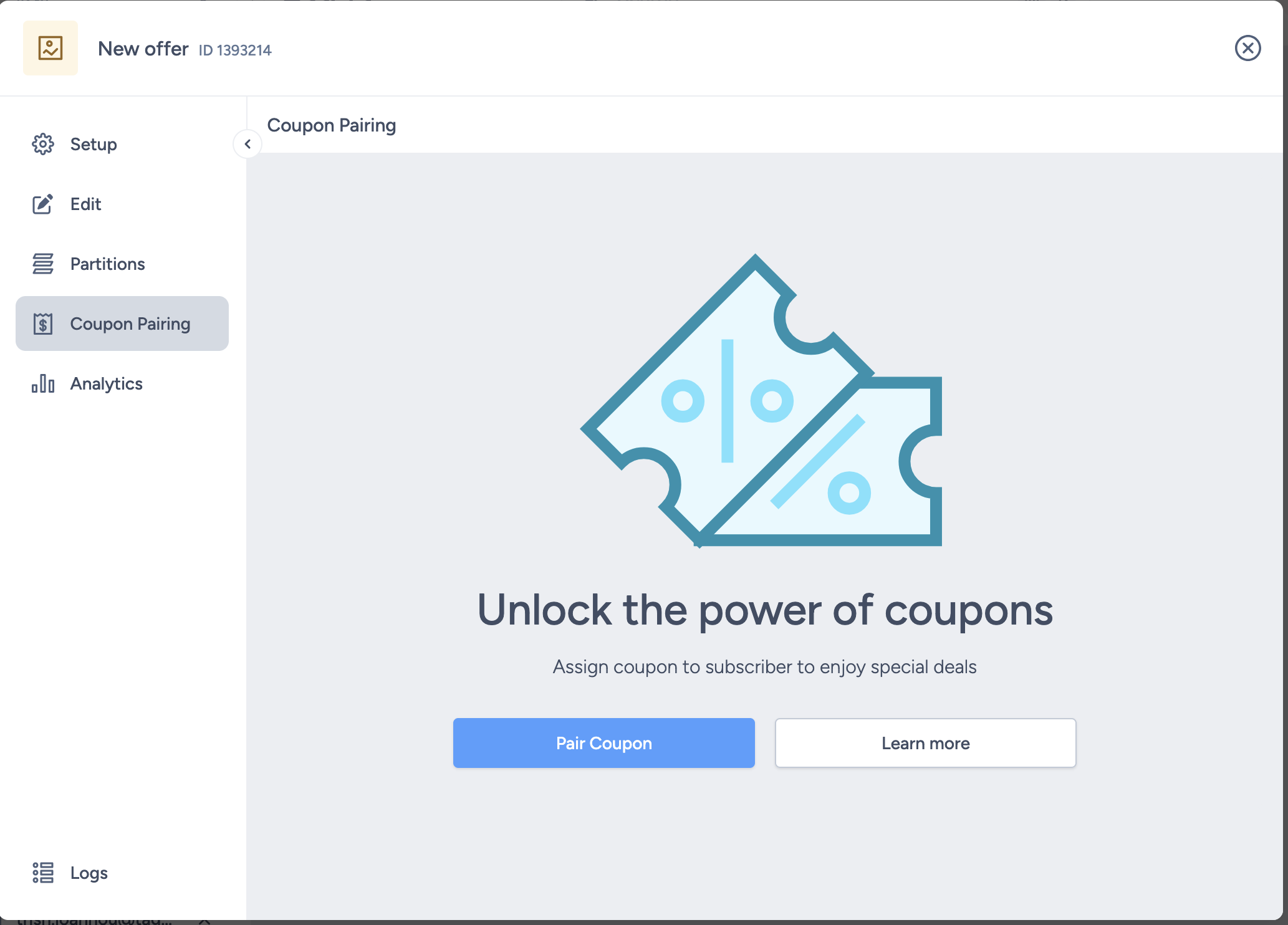
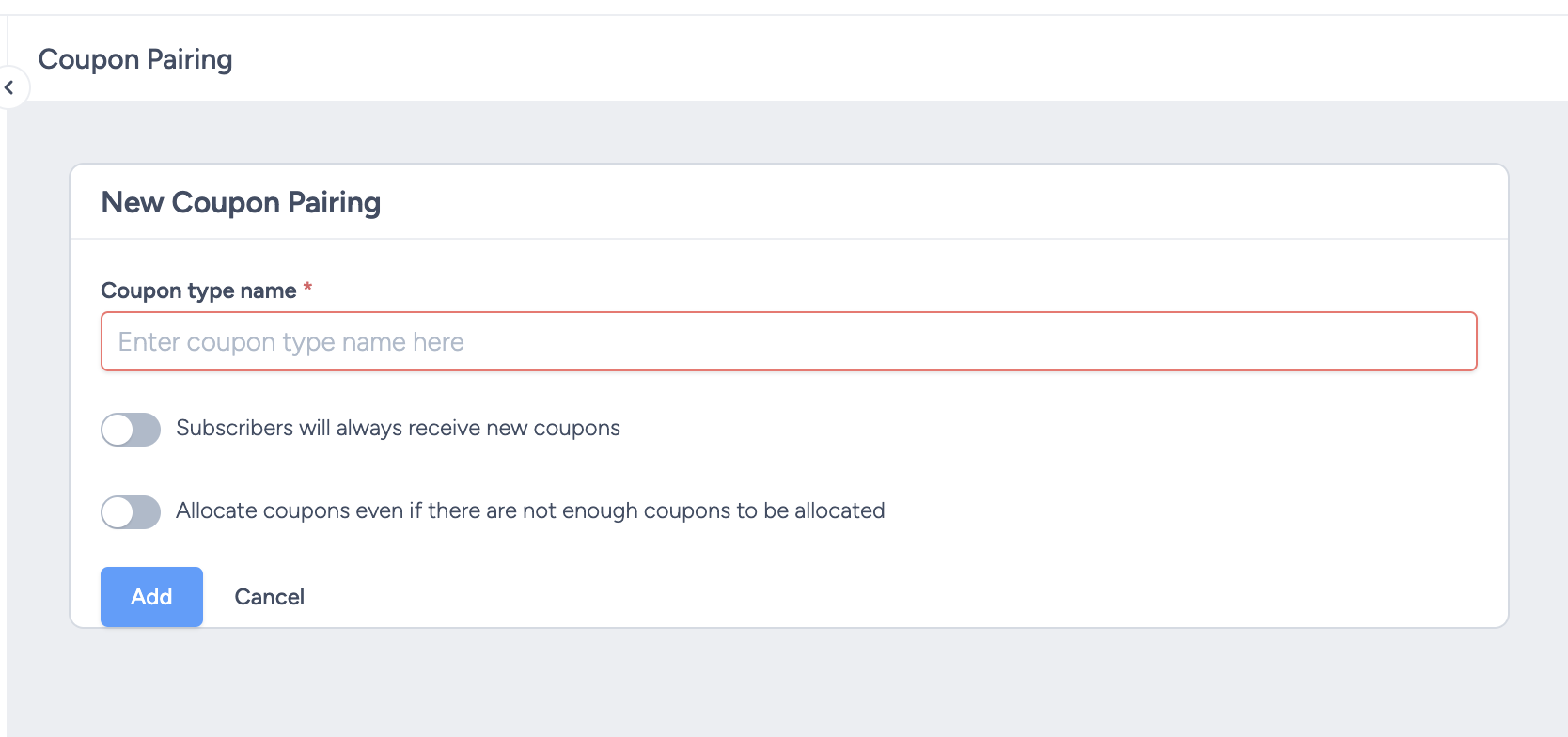
For more information, see 'What are coupons and how can I use them?'
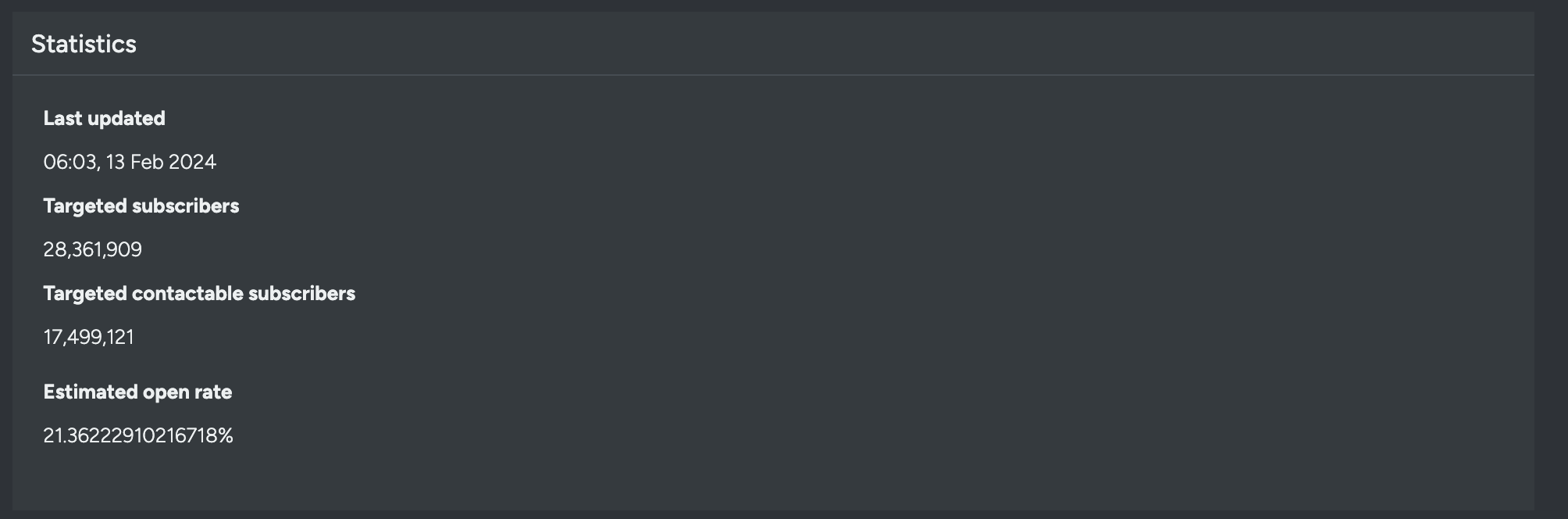
Analytics
- Tagged subscribers - number of subscriber profiles matching this asset’s Target Expression when analytics were last calculated. This is an estimate and does not represent actual asset impressions.
- Contactable subscribers - matching profiles currently contactable through the relevant channel.
- Estimated open rate — Predicted open rate based on historical performance.
Logs
Logs displays the asset’s recorded history, including when changes occurred, the action performed and, where available, the user or system process responsible. Use it to investigate asset changes and operational events. Logs do not represent asset impressions or engagement results.
Bulk Asset Download
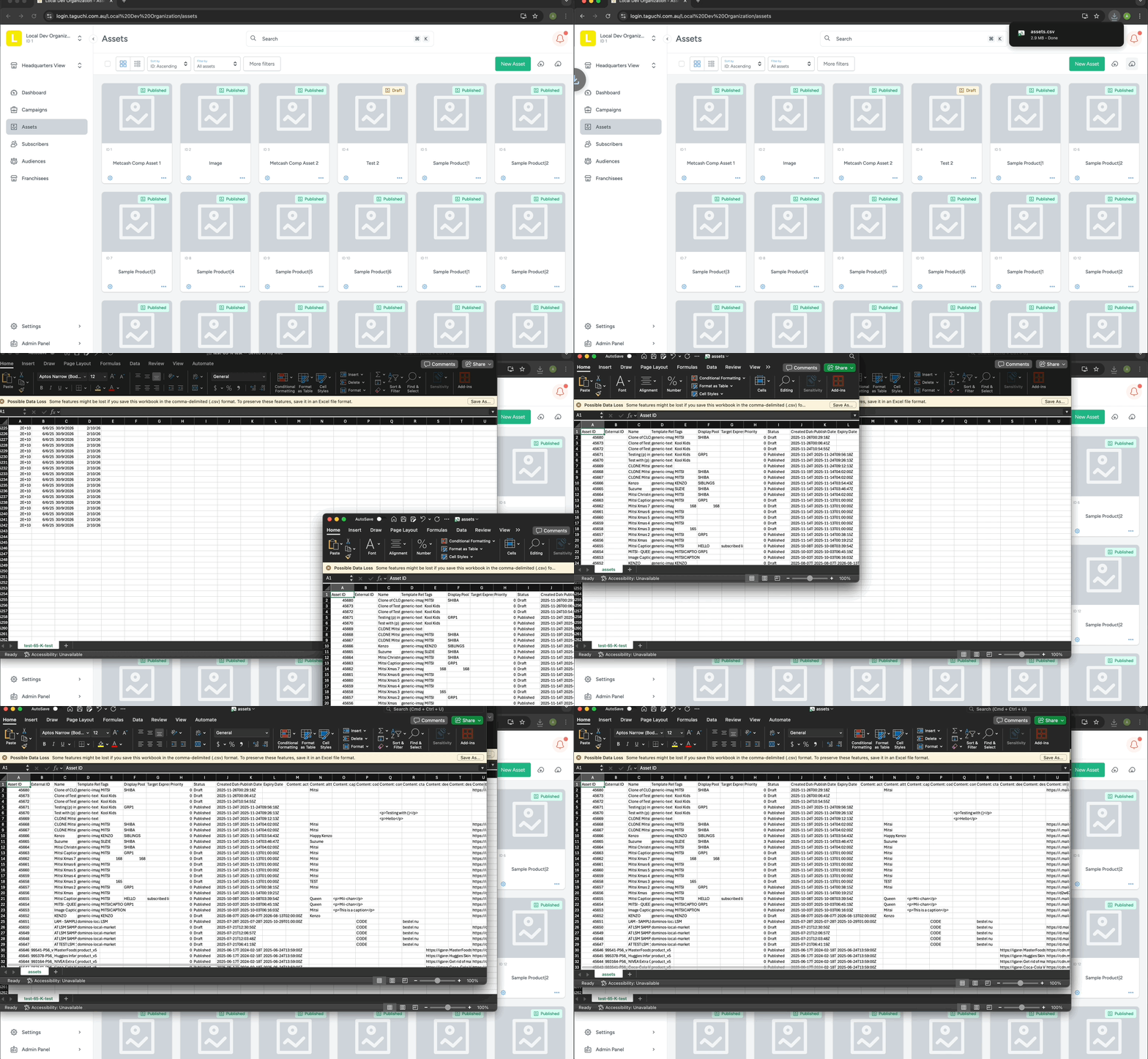
To download all existing assets, select Download Assets in the top-right corner. This generates a CSV file of all assets.
Bulk Asset Creation and Updates
To create or update assets in bulk, click Upload Assets next to New Asset.
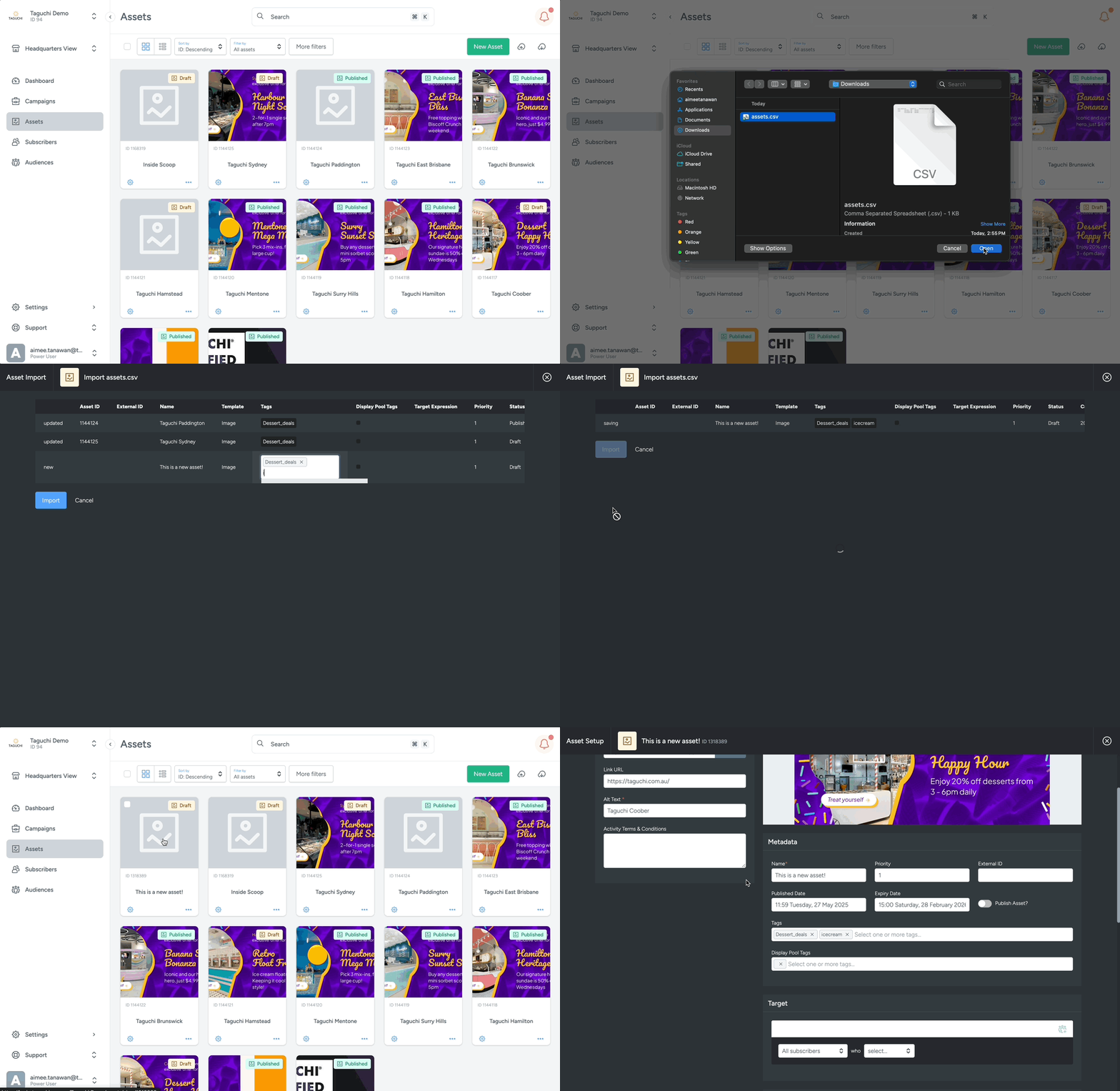
Important:
- The CSV must match the structure of the Bulk Asset Download file.
- To add a new asset, create a new row and fill in the required fields.
Managing assets through the V5 API
In the V5 API, UI assets are represented as API content-block/asset records.
- Retrieve available templates first, then select the appropriate template before creating template-based assets.
- Upload images/files first, then reference the returned file URL or identifier in your asset payload content.
- Use either Taguchi ID (
id) or External ID (ref) consistently with your endpoint permission settings. - Asset delivery is affected by tags, targeting rules, publication windows, priority, and partition opt-in/opt-out state.
For endpoint paths, payloads and responses, refer to the V5 API documentation.
Sorting and Filtering Assets
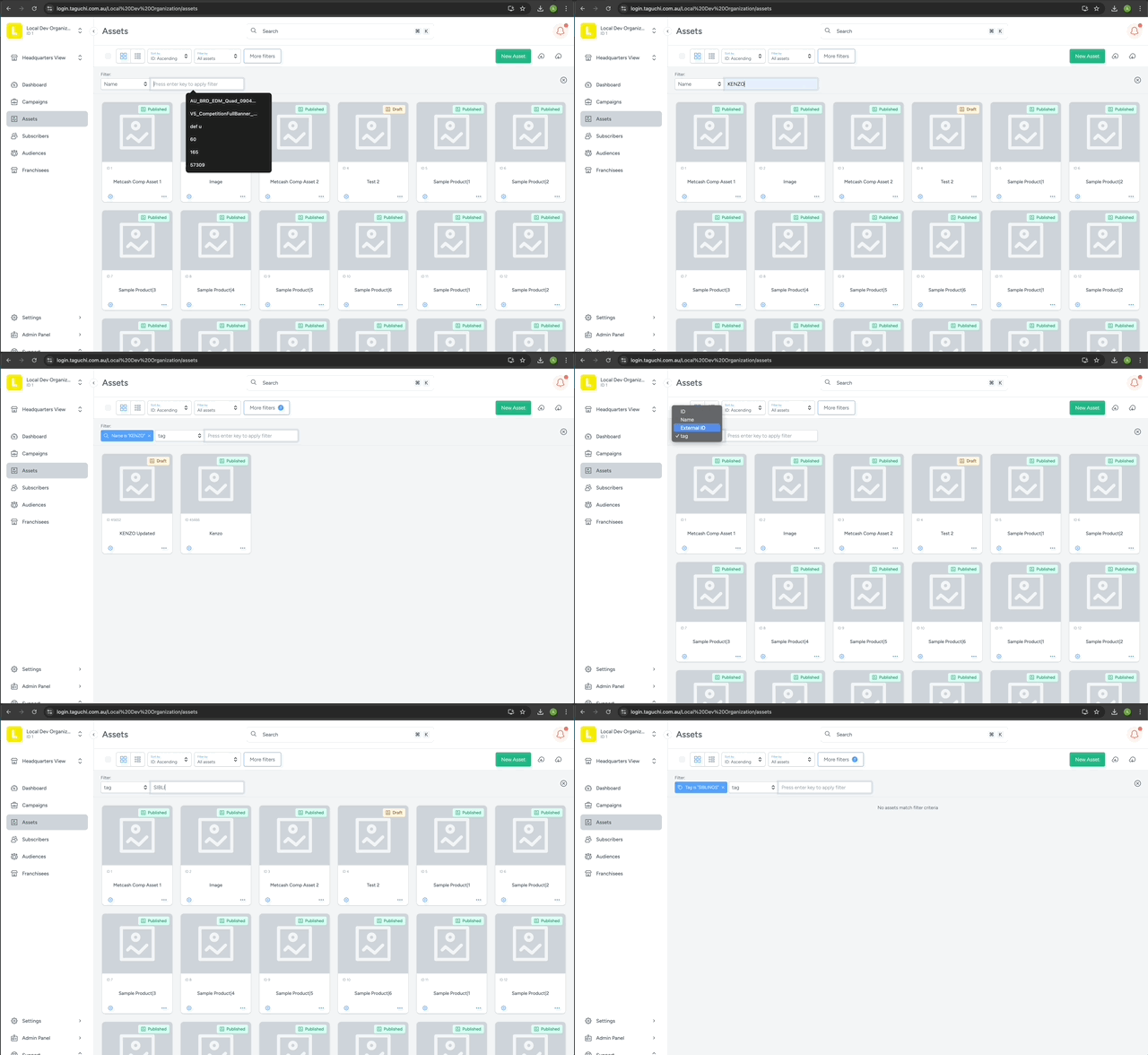
As your Asset Library grows, use Sort by and Filter by to locate assets efficiently.
You can:
- Sort alphabetically or by ID
- Filter by published or archived state
- Use More filters to search by ID, name, external ID, or tag
Adding Dynamic Assets in an Email activity
To add a dynamic asset to an email activity:
- Open the activity editor.
- Go to the Layout tab.
- Drag the Dynamic Asset content block into the email preview.
- Enter one or more values in the Asset Tags field.
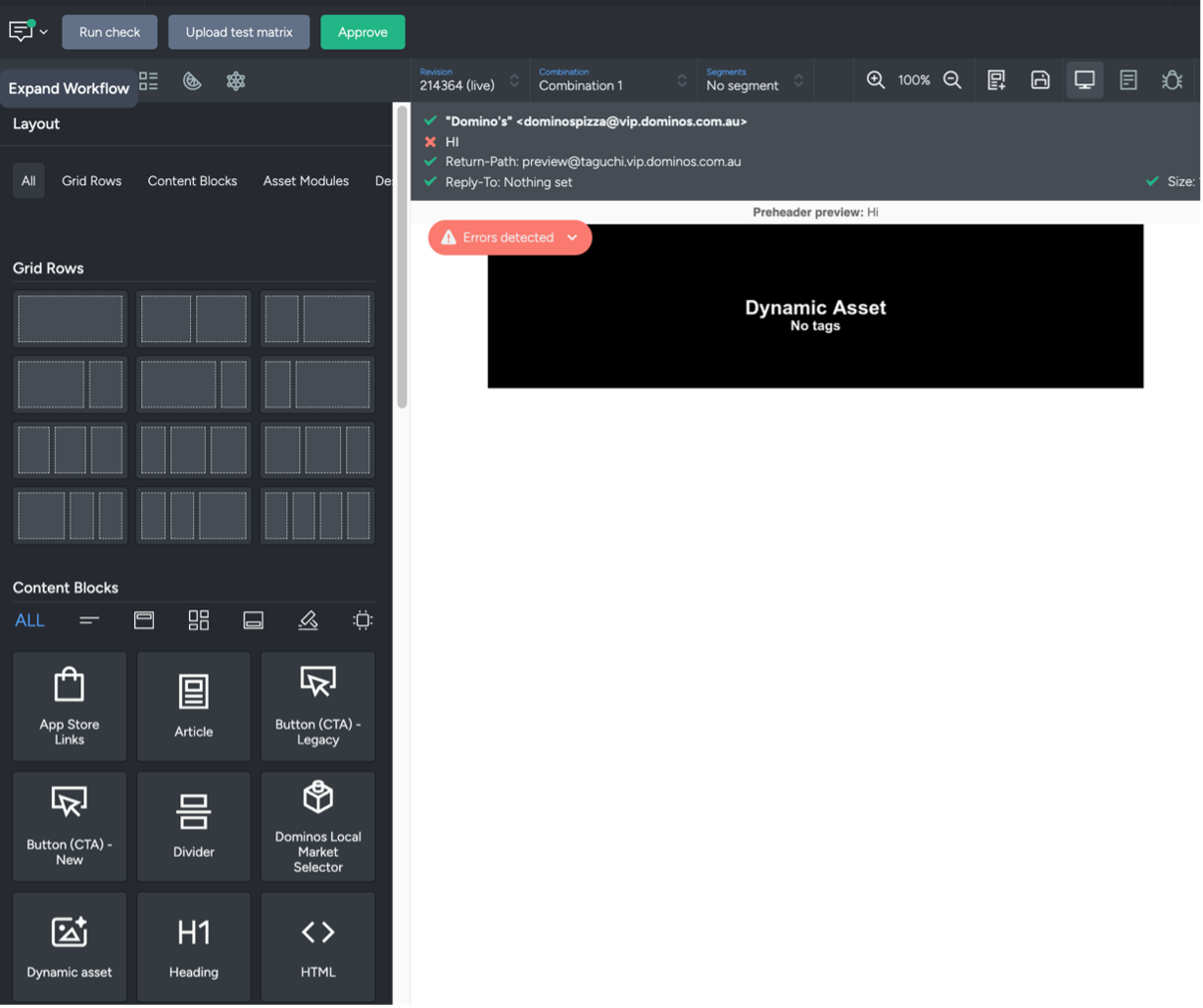
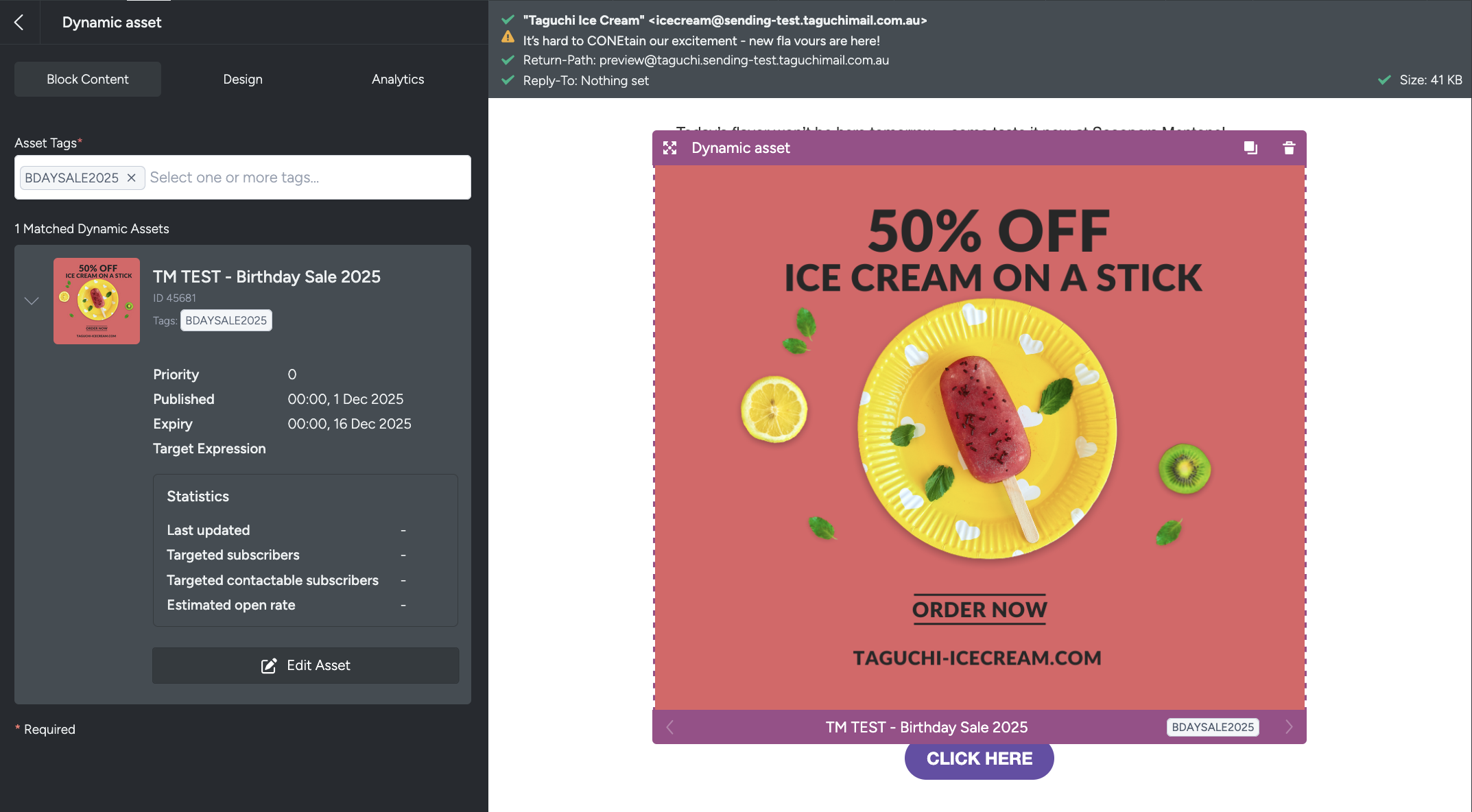
In the editor pane, you can see all assets that match the inputted tags.
If more than one asset is available, the Dynamic Asset block will ensure that only one is displayed in each recipient’s email.
Dynamic-asset selection is resolved in this order:
- Asset is published and not archived
- Current time is within the publication window (published/expiry dates)
- Asset is compatible with the activity channel/type
- Asset matches one or more configured Asset Tags (OR match)
- Subscriber meets the asset target expression
- Display pool restrictions are applied
- Priority determines which eligible asset is selected (lower number = higher priority)
If no asset is eligible, the dynamic block does not render asset content for that subscriber.
Example of using assets in an email
Use Case 1: Display a promotional banner to all recipients during a specific period
Scenario
A birthday sale runs from 1–15 December 2025.
Steps
- Create an image asset and upload the promotional banner.
- Set Published Date: 1 Dec 2025, 12:00 AM
- Set Expiry Date: 15 Dec 2025, 11:59 PM
- Add the tag
BDAYSALE2025. - Add a dynamic asset block in your email and enter
BDAYSALE2025in Asset Tags.
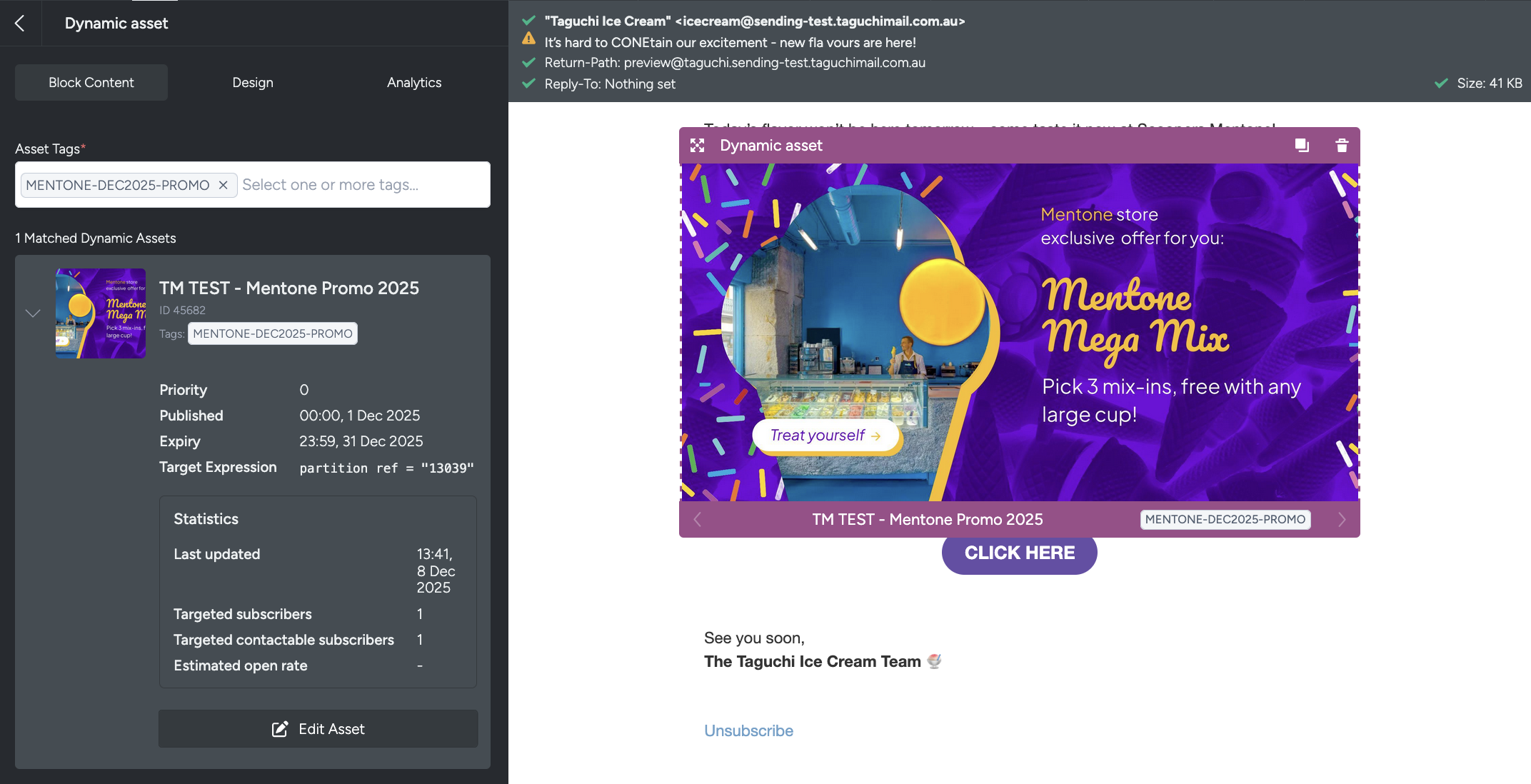
Use Case 2: Show a promotional banner to a specific store’s subscribers
Scenario
The same sale should only appear for Mentone store subscribers.
Steps
- Create/upload the asset.
- Add tag
MENTONE-DEC2025-PROMO. - Add a target expression for partition reference 13039 (Mentone).
- Insert a dynamic asset block and set Asset Tags.
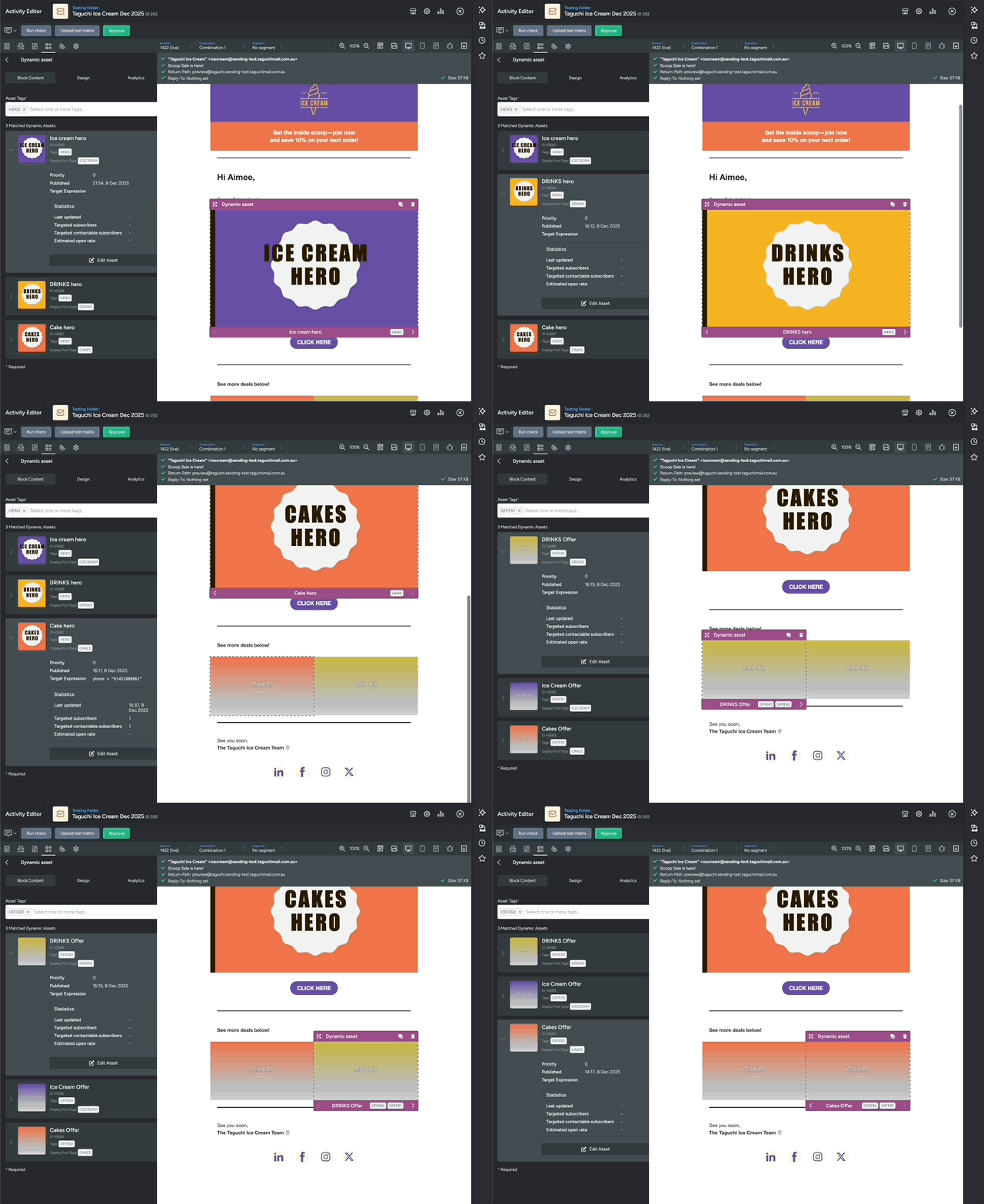
Use Case 3: Avoid duplicate offers by grouping assets
Scenario
You want to promote three items (Ice cream, Cakes, Drinks) without repeating categories.
Setup
Create hero assets and offer assets, assigning Display Pool Tags so only one category appears across placements.
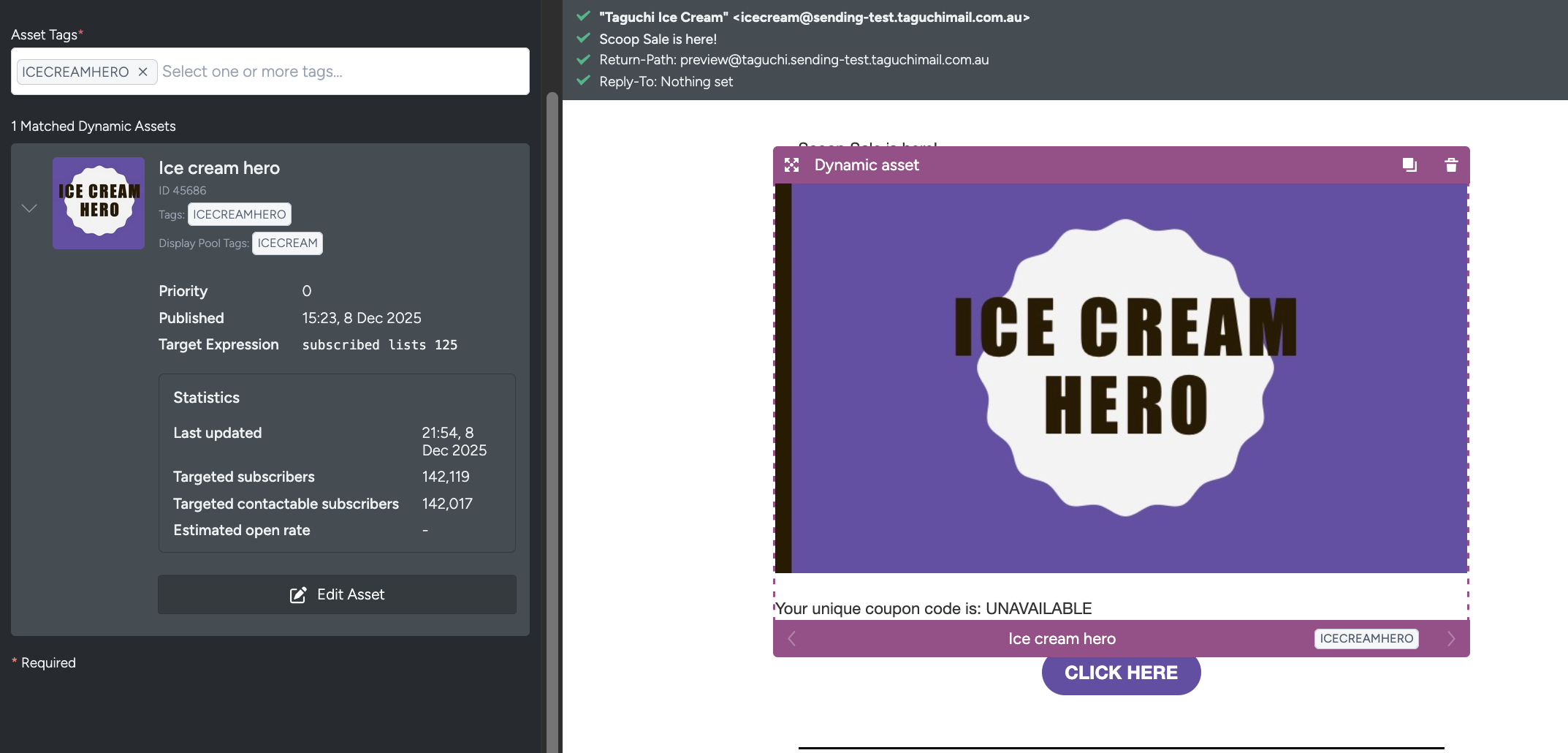
Use Case 4: Display a unique coupon code within an asset
Steps
- Create an image-caption asset.
- Add tag
ICECREAMHERO. - Define the target expression.
- Pair a coupon type.
- Insert the coupon personalisation tag into the caption.
- Add a dynamic asset block using the tag
ICECREAMHERO.
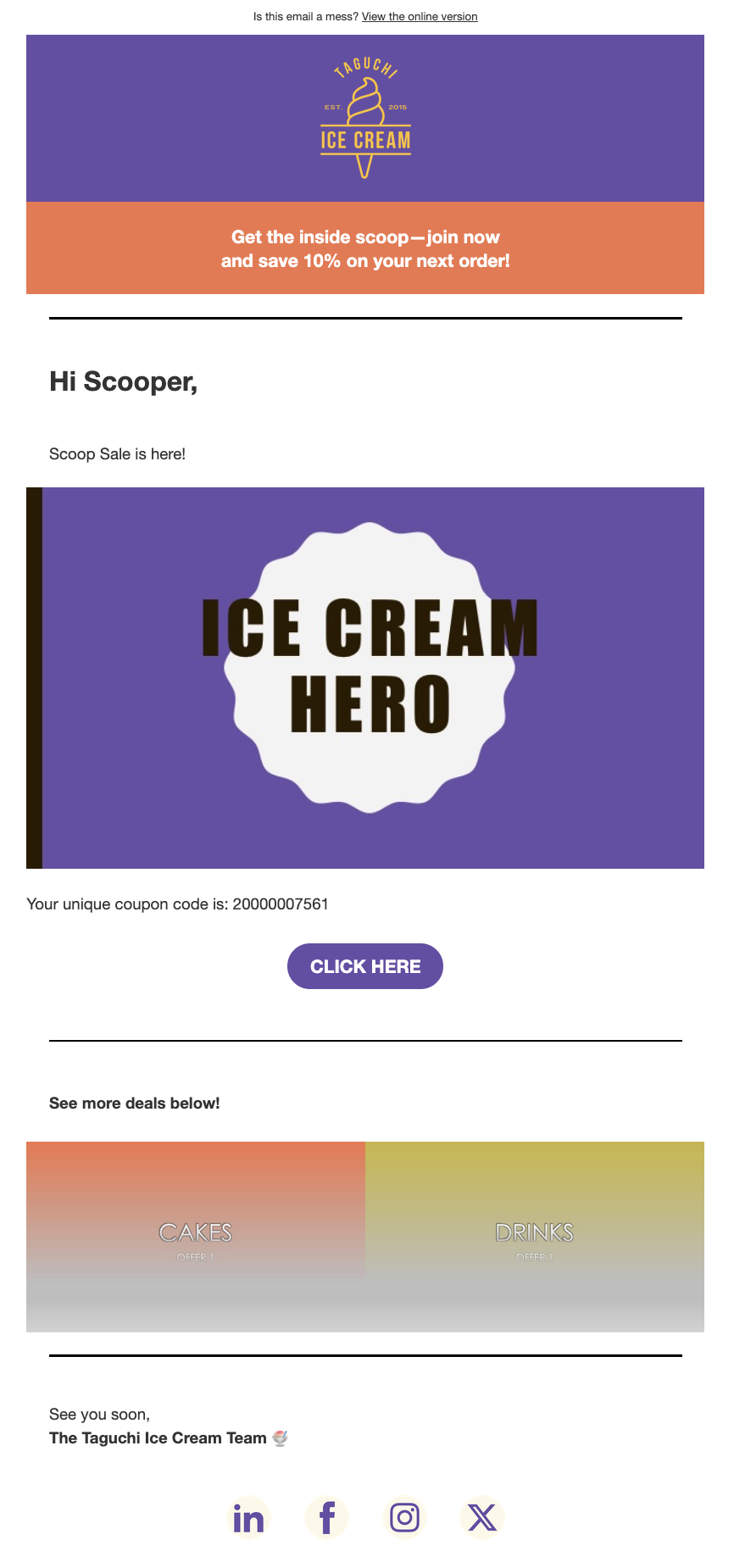
Sample Email:
Further Information
To incorporate dynamic assets into your website or app, see the Website Personalisation guide.
For custom asset requirements or layout support, please contact Taguchi Support.