- Support Home
- Knowledge Base
- Campaigns And Activities
- Proofing
- Test Matrix
Related articles
Need some help?
If you have questions or can't find what you're looking for, we're here to help.
Taguchi Support is available 24 hours a day, Monday to Friday.
Create New TicketAPI Version 5
Did you know Taguchi has an API that supports all of the functionality provided by the admin interface and more?
Explore API Documentation
Thanks for your feedback!
Test Matrix
What is the Test Matrix?
When testing and proofing activities, it is sometimes insightful to see all the outputs of segments which are accounted for in the build process.
The test matrix allows you to create test profiles for each of the segments you wish to test, and outputs sample eDM's if the profiles fall into the target expression inputted for that activity.
This function is useful when you want to see sample emails for specific profiles, such as a subscriber who is in Victoria and has purchased a particular product more than once. It can also help you validate whether the target expression is targeting who you actually want to target.
To use this function, "Work Flow" has to be enabled. Please contact support if you are unsure if "Work Flow" is enabled for your organisation.
How can I run the Test Matrix?
1. Prepare a CSV file containing the profiles you want to test
The file must be in CSV format and contain one profile per row.

Mandatory fields and values
Profile Name: This must be the first column in the file. Give every profile a unique name; it is used to name the.emlfile generated for a targeted profile.email: Include this column when testing an email activity. The address is used as the recipient in the sample email. It does not need to belong to an existing subscriber and may be repeated across profiles.
Other columns are required only when the activity's targeting, segments, or personalisation depend on their values. For example, include List: <id> when testing list membership and Audience: <id> when testing audience membership.
Supported columns
| Column | Value |
|---|---|
Standard profile field, such as firstname, state, or dob |
A value in the same format as the corresponding standard field. |
Custom: <field> |
The value to assign to an existing custom field. |
List: <id> |
An ISO 8601 subscription timestamp when a subscribed date is required. For membership-only tests, use 1, Y, Yes, or true for subscribed, and 0, N, No, or false for not subscribed. |
List Option: <id> |
The subscription-option value to apply for an existing list. |
Audience: <id> |
The profile's audience joined timestamp in ISO 8601 format, for example 2026-08-19T00:00:00Z. Use true/false only when the test requires membership without a joined date. |
partition |
One or more numeric partition IDs. Separate multiple IDs with commas and enclose the cell in double quotes. |
partition_refs |
One or more partition references. Separate multiple references with commas and enclose the cell in double quotes. |
Interaction History |
A JSON array of subscriber events used by the activity's targeting or personalisation. |
Parent Event |
A JSON object representing the event that triggered an event-based activity. |
Column headers must match these formats exactly. Replace <id> or <field> with an existing ID or field name from your organisation.
Audience and partition examples
Use an ISO 8601 timestamp for an audience joined date, particularly when the target expression depends on when the profile joined the audience.
Profile Name,email,Audience: 8341,partition
Test Profile,test@example.com,2026-08-19T00:00:00Z,412
Use partition_refs instead of partition when your matrix stores partition references rather than numeric IDs:
Profile Name,email,Audience: 8341,partition_refs
Test Profile by partition reference,test@example.com,2026-08-19T00:00:00Z,1234
For profiles that belong to multiple partitions, quote the comma-separated value:
Profile Name,email,Audience: 8341,partition
Test Profile in multiple partitions,test@example.com,2026-08-19T00:00:00Z,"412,589"
The profiles in the test matrix don't stay in the database - they are temporarily created when the test is run, and then deleted.
2. Upload a test matrix file
Click "Upload test matrix", and a file explorer dialog will appear to locate your test matrix file. Select your file and click 'Open'.
If there is a "Run test matrix" button instead of an "Upload test matrix" button, it means a test matrix has already been uploaded to the activity.
You can replace the test matrix by clicking ▾ next to the "Run test matrix" button and selecting "Upload test matrix".
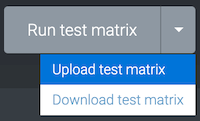
You can't remove a test matrix from an activity, you can only override an existing one.
You can also download the existing test matrix to review the content and make edits for re-upload.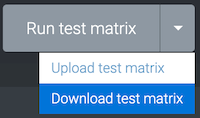
3. Run the test matrix
Once you upload the test matrix file, you can click "Run test matrix" and the test files should start downloading to your computer.
4. Check the files
You will get a folder containing a CSV file and sample emails of targeted profiles.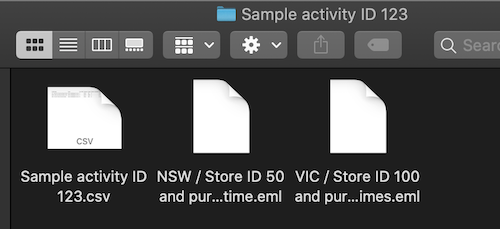
CSV file
This will give you insight on who is targeted, which segment they fall in, and what personalised content they should see.
Targeted: Yes = this profile is included in the activity's target expression, No = this profile is not included in the activity's target expressionSegment: The segments they fall in in the activity
Email files
These are sample emails of the profiles whose 'Targeted' field value is Yes. Each email file name is matched with the profile's unique "Profile Name" in the downloaded CSV file.
When an activity is cloned, the test matrix in it is also cloned.
Troubleshooting Test Matrix Issues
If you encounter issues when uploading or running the test matrix, check the following common causes:
Unable to upload or select the file
- Ensure the file is in CSV format. Other file types (e.g.
.xlsx,.txt) are not supported. - If your file was created in Excel, make sure to save it as CSV (Comma delimited) before uploading.
Incorrect column header spelling
- Column headers must match the expected format exactly (e.g.
Profile Name,email,List: XXXX). - Check for:
- Typos or misspellings
- Extra spaces before or after the header name
- Incorrect casing or formatting
Invalid cell values
- Ensure values follow the expected format:
List: XXXX- use an ISO 8601 subscription timestamp when a subscribed date is required. For membership only, use1,Y,Yes, ortruefor subscribed, and0,N,No, orfalsefor not subscribed.Audience: XXXX- use a full ISO 8601 joined timestamp, such as2026-08-19T00:00:00Z, when testing audience membership and date conditions.partition- use existing numeric partition IDs.partition_refs- use existing partition references.- The list, audience, and partition IDs or references must exist in your organisation and match the activity's targeting configuration.
Custom: <field>- values must match the existing values defined for that custom field in your organisation.
- Avoid empty or malformed values in mandatory fields.
If the issue persists, please contact Taguchi Support for further assistance.